10 Best Global Conflict Maps & War Trackers in 2026 (Compared)
Published: Mar 19, 2026
Tracking armed conflicts in real time has become essential for journalists, analysts, humanitarian workers, and informed citizens. With over 40 active wars and dozens of lower-intensity conflicts burning across the globe in 2026, having the right tool to monitor, understand, and visualize these crises is more important than ever. But not all conflict trackers are created equal. Some focus on data granularity, others on geographic visualization, and still others on policy analysis.
In this comparison guide, we evaluate the 10 best global conflict maps and war trackers available in 2026. We assess each tool based on its data sources, update frequency, usability, depth of coverage, and whether it is free or paid. Whether you need a quick visual overview of current wars or a deep academic dataset for research, this list has you covered. For context on the sheer number of active conflicts these tools are tracking, see our analysis of how many wars are happening in 2025-2026.
How We Evaluated These Tools
Before diving into the list, here is the criteria we used to rank and compare each conflict tracking tool:
- Data freshness: How frequently is the tool updated? Daily, weekly, monthly, or annually?
- Geographic scope: Does it cover all global conflicts, or focus on specific regions?
- Visualization quality: Is there an interactive map? How intuitive is the interface?
- Data depth: Does it provide casualty data, event-level detail, severity scoring, or just summaries?
- Accessibility: Is it free? Does it require academic credentials or a subscription?
- Source transparency: Are data sources clearly cited and methodology explained?
#1Global Conflict Map (conflict.sbs)
Global Conflict Map
conflict.sbs
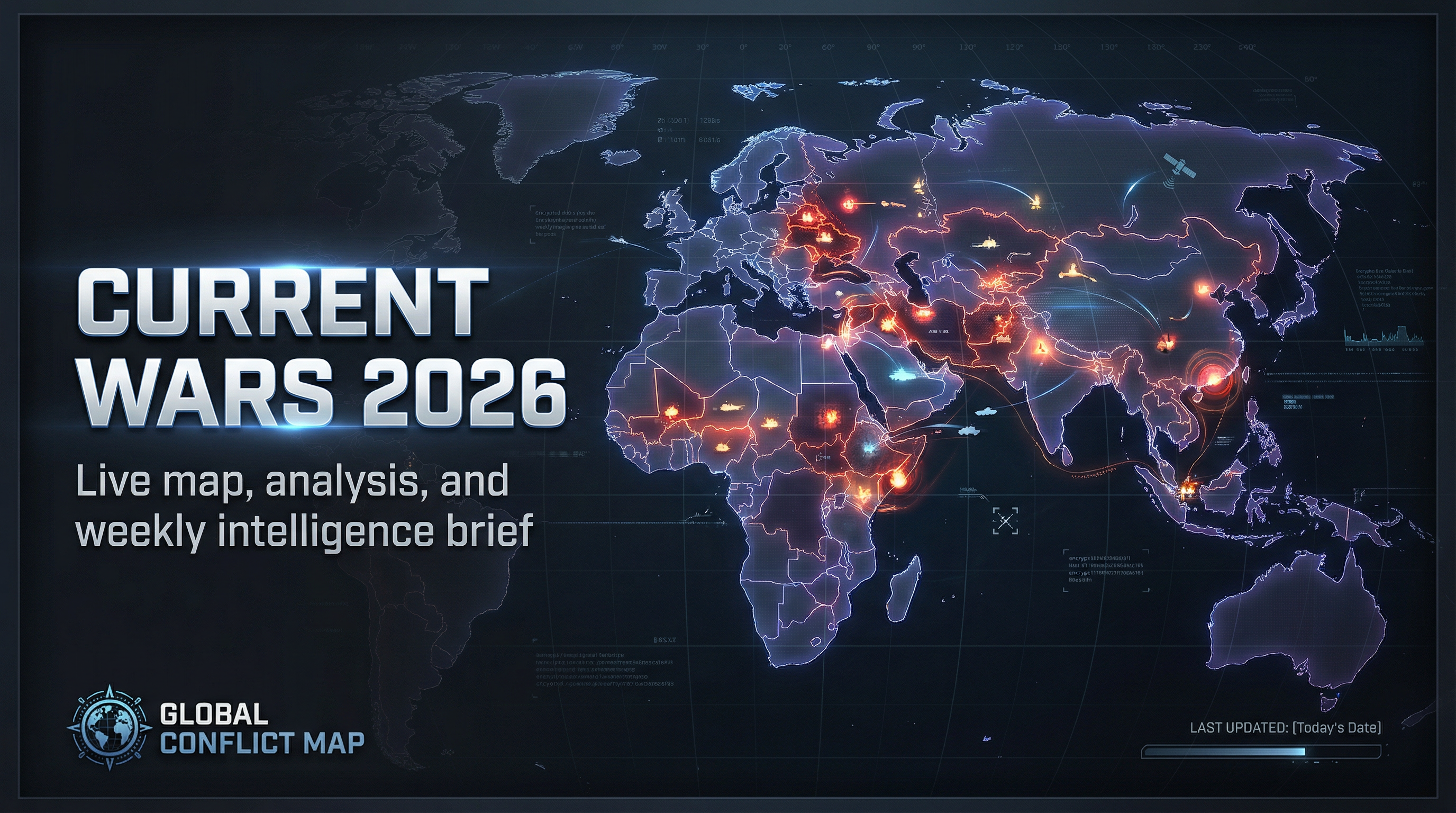
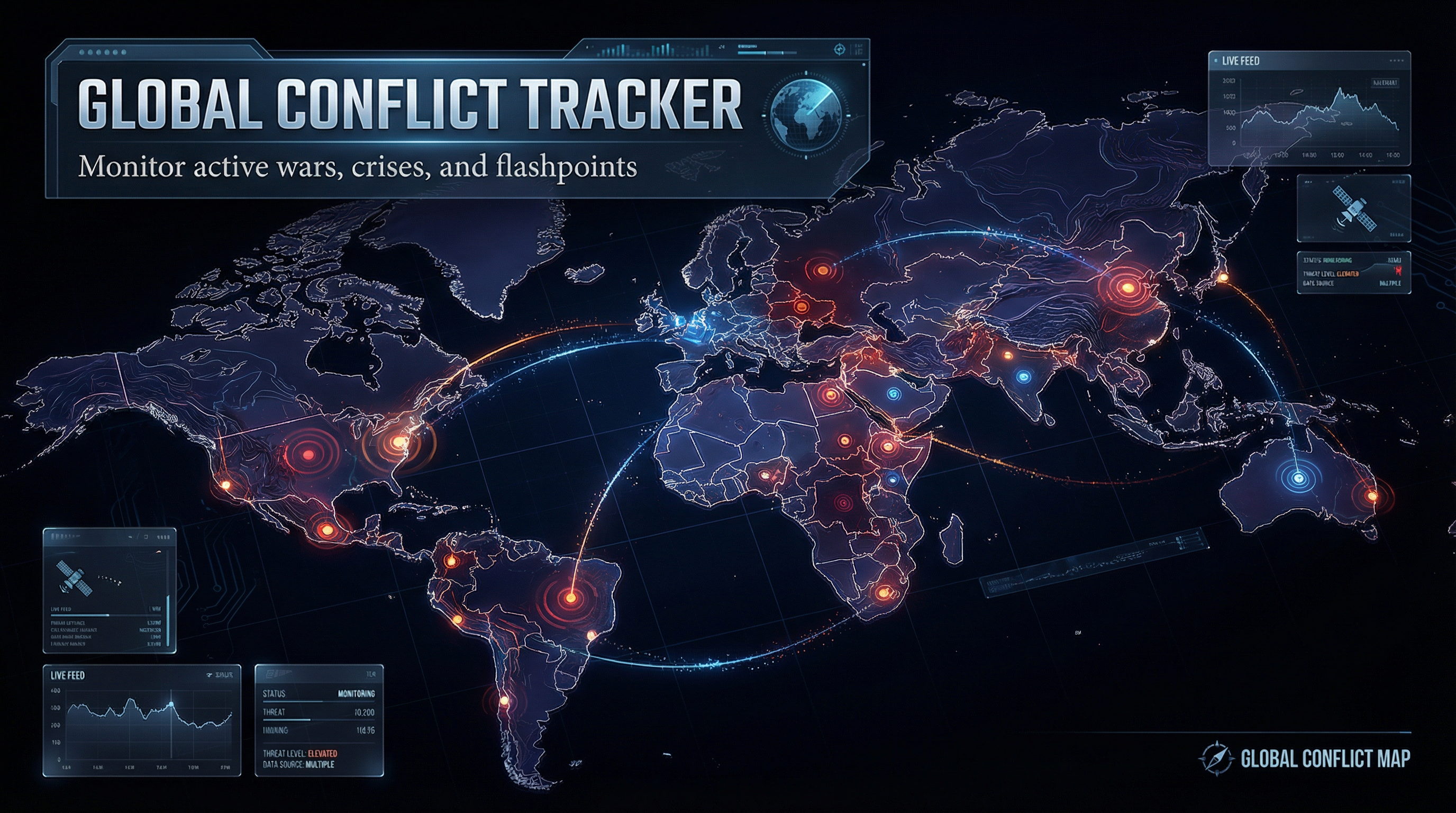
Global Conflict Map is an interactive, real-time conflict tracker that visualizes 46+ active wars and crises across 76 countries on a single dark-themed world map. Built for speed and clarity, it aggregates data from ACLED, the International Crisis Group (ICG), Uppsala Conflict Data Program (UCDP), and the Council on Foreign Relations (CFR) into a unified interface. Each conflict is color-coded by severity level, and clicking any hotspot reveals a detailed briefing with casualty estimates, key actors, timeline, and escalation risk assessment.
What sets Global Conflict Map apart from academic databases or policy-focused trackers is its emphasis on accessibility and real-time visualization. The map loads instantly, works on mobile, and requires no account or subscription. It also features in-depth country-level articles on major conflicts like the Russia-Ukraine war, the Middle East regional war, the Sudan civil war, and the Myanmar civil war, each with frequently updated data and analysis. The platform also publishes a weekly conflict intelligence newsletter that summarizes the most important developments.
Pros
- Free, no account required
- Beautiful interactive map with severity filters
- Aggregates 4+ major data sources (ACLED, ICG, UCDP, CFR)
- In-depth country briefings with casualty data
- Mobile-friendly, fast-loading
- Weekly newsletter with curated analysis
- Covers both active wars and lower-intensity conflicts
Cons
- No downloadable raw dataset (API coming soon)
- Newer platform, smaller brand recognition than established think tanks
- Historical data limited compared to multi-decade academic databases
#2CFR Global Conflict Tracker
Council on Foreign Relations Global Conflict Tracker
cfr.org/global-conflict-tracker
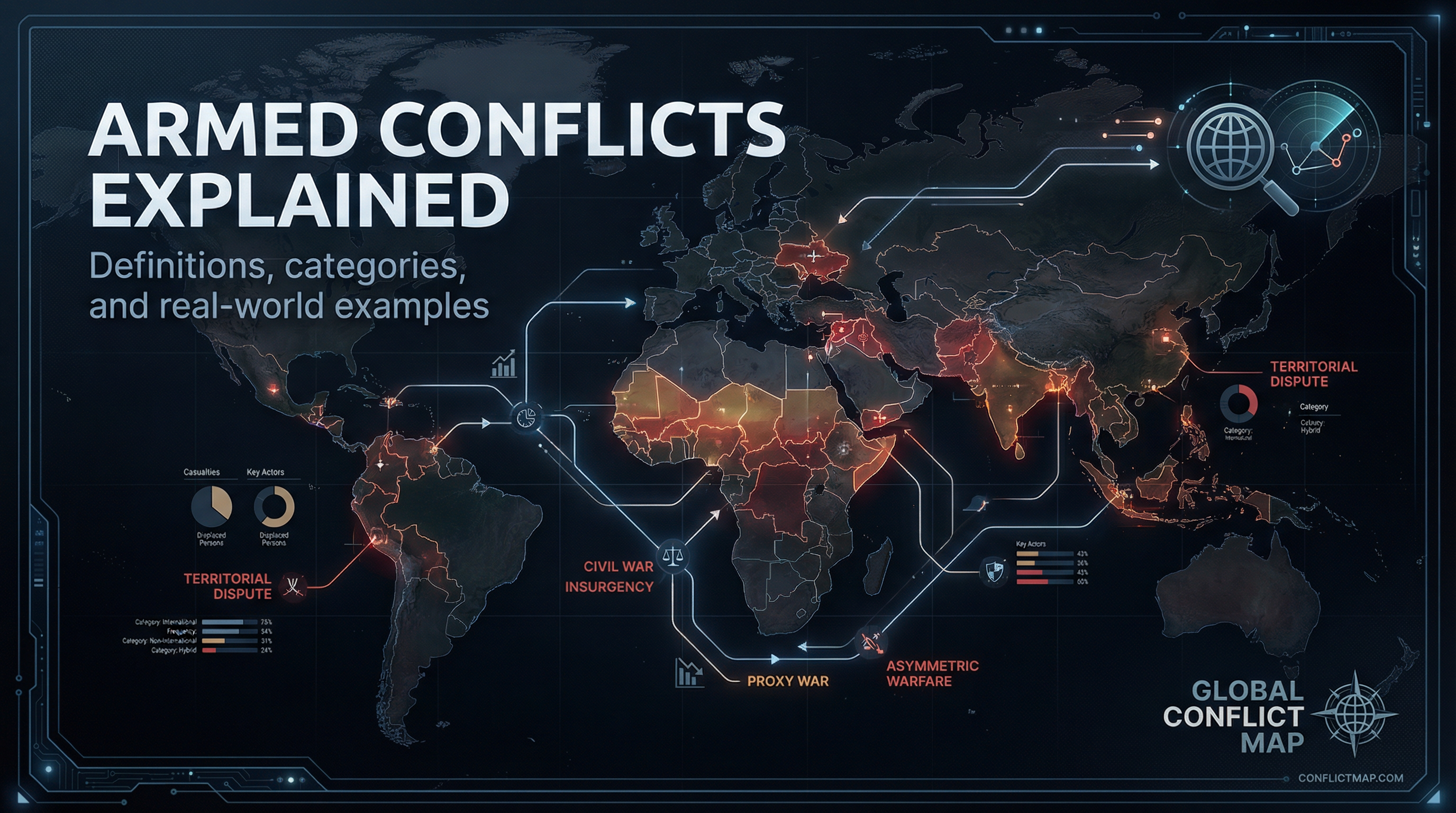
The CFR Global Conflict Tracker is a widely-cited tool maintained by the Council on Foreign Relations, one of America's most influential foreign policy think tanks. It categorizes conflicts by type (territorial disputes, civil wars, criminal violence) and by their impact on U.S. interests (critical, significant, or limited). Each conflict entry includes a background briefing, a timeline, and links to deeper CFR analysis. It is a go-to resource for policymakers, diplomats, and journalists seeking an American foreign-policy lens on global conflicts.
The tracker features a clean world map interface, though it is less interactive than dedicated mapping tools. It covers roughly 25-30 active conflicts at any given time, which makes it less comprehensive than trackers that cover all armed violence globally. For a broader view of all wars in the world today, you may want to cross-reference with other tools on this list.
Pros
- Backed by a highly credible think tank
- Clear categorization by type and U.S. impact
- Excellent briefing quality with context
- Free to access
Cons
- U.S.-centric framing may miss non-Western perspectives
- Covers fewer conflicts than comprehensive trackers
- Map is relatively static, limited interactivity
- Update frequency varies by conflict
#3ACLED Dashboard
Armed Conflict Location & Event Data Project (ACLED)
acleddata.com
ACLED is the gold standard for granular conflict event data. It records individual political violence events — battles, explosions, protests, riots, and violence against civilians — with precise geographic coordinates, dates, actors, and fatality estimates. As of 2026, the ACLED dataset covers over 250 countries and territories, going back to 1997 for African countries and expanding globally since 2018. The ACLED Dashboard provides a map-based visualization layer on top of this enormous dataset.
For researchers and data analysts, ACLED is unmatched. Its downloadable datasets power much of the academic literature on armed conflict, and tools like the Global Conflict Tracker and our own conflict map draw on ACLED data. However, the sheer volume and granularity can be overwhelming for casual users who just want to know what is happening right now.
Pros
- Most granular conflict event data available
- Covers 250+ countries with event-level detail
- Downloadable datasets for research
- Weekly data updates
- Used by UN, World Bank, and leading academics
Cons
- Steep learning curve for non-researchers
- Dashboard is functional but not visually polished
- Free access requires registration
- Raw data requires processing to extract insights
#4Uppsala Conflict Data Program (UCDP)
Uppsala Conflict Data Program (UCDP)
ucdp.uu.se
The UCDP, based at Uppsala University in Sweden, is the oldest and most established academic conflict dataset in the world, with continuous data collection since 1946. It defines armed conflict using strict thresholds (25 battle-related deaths per year), making it the most methodologically rigorous source for understanding long-term trends in global warfare. The UCDP Georeferenced Event Dataset (GED) provides event-level data with geographic coordinates, while the broader UCDP/PRIO dataset tracks all state-based, non-state, and one-sided violence globally.
The UCDP website includes an interactive map and encyclopedia of conflicts. It is particularly valuable for understanding whether the number of conflicts worldwide is increasing or decreasing over time, and for comparing the current landscape to historical patterns. Its annual updates, however, mean it lags behind real-time events.
Pros
- Data going back to 1946, longest continuous dataset
- Strict academic methodology
- Free and fully downloadable
- Conflict encyclopedia with detailed summaries
- Standard reference for academic research
Cons
- Annual updates mean significant data lag
- Strict thresholds exclude low-intensity violence
- Map interface is basic
- Less useful for real-time monitoring
#5Liveuamap
Liveuamap
liveuamap.com
Liveuamap began as a crowdsourced mapping tool for the Ukraine conflict in 2014 and has since expanded to cover conflicts in Syria, the Middle East, Africa, and beyond. It is one of the most popular real-time conflict maps among open-source intelligence (OSINT) analysts and news followers. Events are plotted on a map as they happen, sourced from social media, news reports, official statements, and verified OSINT contributors. Each event pin links to the source, making it excellent for following the Russia-Ukraine war in near real-time.
Liveuamap's strength is its speed: events often appear within minutes of being reported. However, this speed comes at the cost of verification rigor, and the quality of sourcing varies. It is a powerful tool for situational awareness but should be cross-referenced with more authoritative sources for analysis.
Pros
- Near real-time event mapping
- Events linked to original sources
- Covers multiple conflict zones
- Strong community of OSINT contributors
- Free basic access
Cons
- Source quality varies, not all events verified
- Interface can be cluttered with too many pins
- Premium subscription needed for full features
- Coverage depth uneven across regions
#6International Crisis Group CrisisWatch
International Crisis Group — CrisisWatch
crisisgroup.org/crisiswatch
CrisisWatch is the monthly global conflict tracker published by the International Crisis Group (ICG), one of the world's premier conflict prevention organizations. Each month, it provides a concise overview of 70+ situations worldwide, flagging which ones deteriorated, which improved, and which are at risk of escalation. It uses a clear traffic-light system that makes it easy to scan the global landscape at a glance.
ICG's analysis is policy-oriented and forward-looking, making it particularly valuable for understanding not just what happened, but what might happen next. The monthly format strikes a balance between real-time granularity and considered analysis. CrisisWatch is one of the data sources used by our global conflict tracker, and its assessments inform the escalation risk ratings on our map.
Pros
- Highly authoritative, policy-grade analysis
- Clear deterioration/improvement flags
- Covers 70+ situations monthly
- Forward-looking risk assessment
- Free access
Cons
- Monthly updates only
- No interactive map, text-based format
- Summaries are brief, deeper reports behind paywall
- No downloadable data
#7Wikipedia: List of Ongoing Armed Conflicts
Wikipedia — List of Ongoing Armed Conflicts
en.wikipedia.org
Wikipedia's List of Ongoing Armed Conflicts is one of the most frequently visited conflict reference pages on the internet. Maintained by a dedicated community of editors, it categorizes active conflicts by intensity (major wars with 10,000+ deaths/year, wars with 1,000-9,999 deaths/year, and minor conflicts). Each entry links to the full Wikipedia article on that conflict, providing an encyclopedic depth of context. The page is updated almost daily by community editors.
While Wikipedia is not a primary data source, its strength lies in accessibility and comprehensiveness. It is often the first place people look when they want to know how many wars are currently active. The casualty figures cited on the page are drawn from ACLED, UCDP, and other sources, though they may not always reflect the latest data.
Pros
- Free, no registration
- Most comprehensive list of active conflicts
- Updated near-daily by community
- Links to detailed articles on each conflict
- Intensity categorization
Cons
- No map visualization
- Community-edited, quality varies
- Not a primary data source
- No systematic methodology
#8Armed Conflict Survey (IISS)
Armed Conflict Survey by IISS
iiss.org/publications/armed-conflict-survey
The Armed Conflict Survey is an annual publication by the International Institute for Strategic Studies (IISS), a London-based think tank renowned for its Military Balance series. The survey provides deeply analytical, narrative-driven assessments of major armed conflicts worldwide. Each conflict chapter is written by regional experts and includes context, dynamics, prospects, and data visualizations.
Unlike data-centric tools, the Armed Conflict Survey offers the kind of expert interpretation and strategic context that is difficult to find elsewhere. It is the gold standard for qualitative conflict analysis. However, it is published annually and requires a paid subscription or institutional access, which limits its accessibility for casual users tracking current wars.
Pros
- Expert-written, deeply analytical
- Excellent visualizations and maps
- Covers political, military, and humanitarian dimensions
- Trusted by governments and defense analysts
Cons
- Paid subscription required
- Annual publication, not real-time
- No interactive map or dashboard
- Not designed for quick reference
#9GDELT Project
GDELT Project (Global Database of Events, Language, and Tone)
gdeltproject.org
The GDELT Project is one of the largest open datasets of human activity on the planet. It monitors news media from nearly every country in over 100 languages, extracting events, actors, themes, emotions, and geographic references in near real-time. Updated every 15 minutes, GDELT captures not just conflict events but the broader media ecosystem around them, including tone, narrative framing, and source diversity.
GDELT is extraordinarily powerful for computational analysis but is not a traditional conflict tracker. It does not categorize conflicts or provide analyst-written summaries. Instead, it offers a firehose of media-derived event data that researchers and data scientists can filter and analyze. For those who want to understand how wars in the world are being covered by media, GDELT is unmatched.
Pros
- Updated every 15 minutes
- Covers 100+ languages and nearly all countries
- Free and fully open
- Captures media tone and narrative framing
- Massive historical archive
Cons
- Not a conflict tracker per se, media-derived data
- Requires technical skills to use effectively
- High noise-to-signal ratio without filtering
- No curated conflict summaries or analysis
#10Peace Research Institute Oslo (PRIO)
Peace Research Institute Oslo (PRIO)
prio.org
PRIO is a Norwegian peace research institute that, in collaboration with Uppsala University, co-maintains the UCDP/PRIO Armed Conflict Dataset, one of the most cited datasets in political science. PRIO also produces its own Conflict Trends reports, battle-death estimates, and research on the causes and consequences of armed conflict. Its annual Conflict Trends report provides an invaluable snapshot of how global violence is evolving.
PRIO is best suited for academics, policymakers, and students who need peer-reviewed conflict data and analysis. Its datasets are freely available and have been used in thousands of academic papers. While it does not offer a real-time dashboard, its historical depth and analytical rigor complement the more current tools on this list. If you want to understand the bigger picture of global conflicts over decades, PRIO is essential.
Pros
- Co-maintains the most cited conflict dataset (UCDP/PRIO)
- Annual Conflict Trends report
- Free datasets and publications
- Peer-reviewed, academically rigorous
Cons
- No real-time tracking or interactive map
- Academic orientation, less accessible for general public
- Annual publication cycle
- Overlaps significantly with UCDP
Quick Comparison Table
| Tool | Update Frequency | Interactive Map | Data Download | Price | Best For |
|---|---|---|---|---|---|
| Global Conflict Map | Weekly | Yes | Coming soon | Free | Visual overview + analysis |
| CFR Tracker | Varies | Basic | No | Free | U.S. policy perspective |
| ACLED | Weekly | Yes | Yes | Free (reg.) | Granular event data |
| UCDP | Annual | Basic | Yes | Free | Academic research |
| Liveuamap | Real-time | Yes | No | Freemium | OSINT / breaking events |
| ICG CrisisWatch | Monthly | No | No | Free | Policy analysis / risk |
| Wikipedia | Near-daily | No | No | Free | Quick reference |
| IISS Survey | Annual | No | No | Paid | Expert strategic analysis |
| GDELT | Every 15 min | Basic | Yes | Free | Computational analysis |
| PRIO | Annual | No | Yes | Free | Historical trends |
Which Tool Should You Use?
The best conflict tracker depends on what you need it for. Here is a quick guide:
- For a quick visual overview of all active conflicts: Global Conflict Map or the CFR Tracker.
- For academic research with downloadable data: ACLED (event-level) or UCDP (aggregate, long-term).
- For real-time OSINT monitoring of specific conflicts: Liveuamap.
- For monthly policy briefings: International Crisis Group CrisisWatch.
- For computational media analysis: GDELT Project.
- For deep expert analysis (and you have budget): IISS Armed Conflict Survey.
For most users who want an accessible, visually rich, and regularly updated overview of wars in the world today, we recommend starting with the Global Conflict Map and supplementing with ACLED or CrisisWatch for deeper dives. For a step-by-step workflow on how to combine these tools effectively, see our guide on how to track wars and armed conflicts in real time.
Frequently Asked Questions
What is the best free conflict map?
For a free, interactive conflict map that combines real-time data with analysis, Global Conflict Map (conflict.sbs) offers the best balance of visual clarity, data depth, and accessibility. It requires no account or subscription and covers 46+ active conflicts.
How many armed conflicts are active in 2026?
Depending on the definition and threshold used, there are between 40 and 110+ active armed conflicts in 2026. Our war count analysis explains the different methodologies and why the numbers vary so widely between sources.
What is the difference between ACLED and UCDP?
ACLED provides event-level data (individual battles, protests, explosions) updated weekly, while UCDP provides aggregate conflict-level data (entire wars classified by type) updated annually. ACLED is better for current monitoring; UCDP is better for long-term historical analysis.
Where can I find reliable war news?
For a curated guide to the best sources for conflict news, see our companion article on the best war news sources in 2026.
Weekly Conflict Intelligence Brief
Get a curated summary of the week's most important conflict developments delivered every Monday. Trusted by analysts, journalists, and researchers.
Most Important Guides Right Now
Featured Briefing
Sudan War Update: Armed Fighting, Displacement, and Risk
Follow Sudan's civil war between the SAF and RSF — over 10,000 killed, 8 million displaced — through battlefield shifts, humanitarian collapse, and regional spillover scenarios into Chad and Egypt.
Featured Briefing
Haiti Crisis Tracker: Violence, Governance, and Instability
Track Haiti's gang-driven crisis — controlling 85% of Port-au-Prince — with updates on insecurity, government collapse, 700,000+ displaced, and the limited international response options available.
Featured Briefing
Somalia Conflict Update: Insurgency, Security, and Outlook
Monitor Somalia's ongoing conflict against Al-Shabaab insurgents — active across 60% of the south — with context on security operations, AU mission drawdown, and future escalation risk.